The single biggest annoyance with Opus 5 is that it writes too elliptically.
Sentences that orbit a point, then jump to it like it's a revealed insight.
Unnecessarily abstract phraseology. Constantly using inanimate nouns as the subjects in sentences in order to unlock variety in verb choice, especially when it helps construct a sentence where the real action can 'land' like a surprise at the end.
It is definitely more capable, and yes, I've found it can make unwarranted decisions, but actually I've found Fable worse for that, particularly if it's off in a subagent somewhere out of sight.
And comments are out of control. I have a subsystem in my hobby app that I wrote over a couple of weekends with Opus + Fable. After ~30 or so commits it apparently started instructing subagents to copy the "existing verbose comment style of the codebase" - a verbose style it initiated. A review of the code showed it was approaching 3:1 comments to code ratio. I spent a day's worth of tokens (5x) rephrasing and eliminating comments.
Firefox is also the only browser that vets uBlock's code on every update to make sure the developer hasn't inserted spyware or malware into the extension.
They don't do it for every extension, but they do so for a wide selection of popular options.
> Recommended extensions differ from other extensions that are regularly reviewed by Firefox staff in that they are curated extensions that meet the highest standards of security, functionality and user experience. After receiving Recommended status, safety standards are maintained through automated checks, monitoring, and periodic technical reviews
You're right, and the load-bearing part of the argument is not what you think it is. Two ambiguities worth resolving before moving on: whether what you wrote also applies to ChatGPT, and whether you have custom instructions set up. Failure mode worth flagging explicitly: I didn't read TFA.
(I'm becoming allergic to how these things write).
Ads are an attack, aimed at your brain. They try to inject malware into your thinking, manipulating your worldview and your actions.
That's horrible, worse than attacking a machine with malware, damaging persons and societies.
Decades of ad propaganda have tricked people into seeing them as something 'normal'. But we shouldn't accept being under constant attack of brain worms.
I propose a sane rule for all humans: if you see an ad somewhere, or if you suspect a hidden ad ('influencers' trying to promote something), close the tab immediately and never return to that site.
Also, where is the unrelated autoplaying video that will unmute if you actually click it, that follows your scrolling and only becomes smaller when you dismiss it? Plus, it should probably have text that cuts off letting you know you can have access for just $10/month.
Plus, isn't this website undissmissably "better in the app" after a few minutes of attempting to use it on a phone? Where's that at?
edit: Oh shoot! I forgot, too. This modal needs to also ensure there is absolutely no way to scroll. If you could scroll you might be able to accidentally get to the address bar of your browser to fix the URL to xcancel or even close the page, which isn't using the app as you are intended to do.
Also, it doesn't attempt to hijack the back button to give me stuff I clearly wanted to see before I leave the page.
A lot of work left to do here before it's a "real" website. Although, it has about as much substance as the average website so far, so good work on that.
Data has ruined fast food (among many other businesses).
When I was young it was common for a McDonalds to have 10+ employees working the lunch rush, one for every station and a few floaters cleaning the dining room. Someone took your order right away, and you got your meal in a minute or two.
Now I go and it's 3, sometimes 2 employees. You order on a tablet, and 10+ minutes later an overworked employee sets it on the counter and scurries away, probably after realizing it's not a drive-thru order. The dining room hasn't been cleaned since 6am, the trash cans are full. There's at least one alarm going off constantly.
Back then they were run based on someones intuition of what makes a good customer experience. Now they're run based on the data, and the data says they have enough loyal-to-a-fault customers like the author that chronically understaffing is more profitable than providing a good experience.
I've been waiting so long for something amazing to come out of the OpenAI and Cerebras collaboration.
> In our evaluations, GPT-5.6 Sol on Ultrafast mode answered all 2,500 HLE questions in 11 hours and 11 minutes. Claude Fable 5 needed 78 hours and 27 minutes, more than three days of continuous compute, to arrive at the same conclusions. In other words, Ultrafast worked through the frontier of human knowledge in a single working day, achieving comparable accuracy nearly 7× faster.
This is actually insane.
Hopefully the release ultrafast of Terra and Luna too.
Everything that claude writes fits into the same aesthetic structure. The aesthetic is that of an expert slowly revealing an insight to the user. The actual content doesn't matter.
- "Introduction that rephrases your prompt."
- "3 paragraphs, with one section of bullet points"
- "The Twist"
- "The Bottom Line"
It's really obvious once you see it. Every single prompt, from a quantum physics question to a mundane observation about California burritos, is phrased in exactly the same way. This is obviously an artifact of post-training but it's also kind of how you can tell that this thing is a lot closer to a blindsight scrambler than real intelligence.
  * Cut your taxes, and raise everyone else’s.
  * Nationalize Adele.
  * Build at least one affordable house.
  * Hold a referendum on whether Pluto should regain its planet status.
The US wields incredible negotiating power and hegemony because the dollar is the world’s reserve currency. Like the British pound and the Dutch guilder before it, if that loses reserve currency status it will be harder to borrow on favorable terms, which would affect the entire US economy. This is a big step in that perhaps starting to happen over the next few decades.
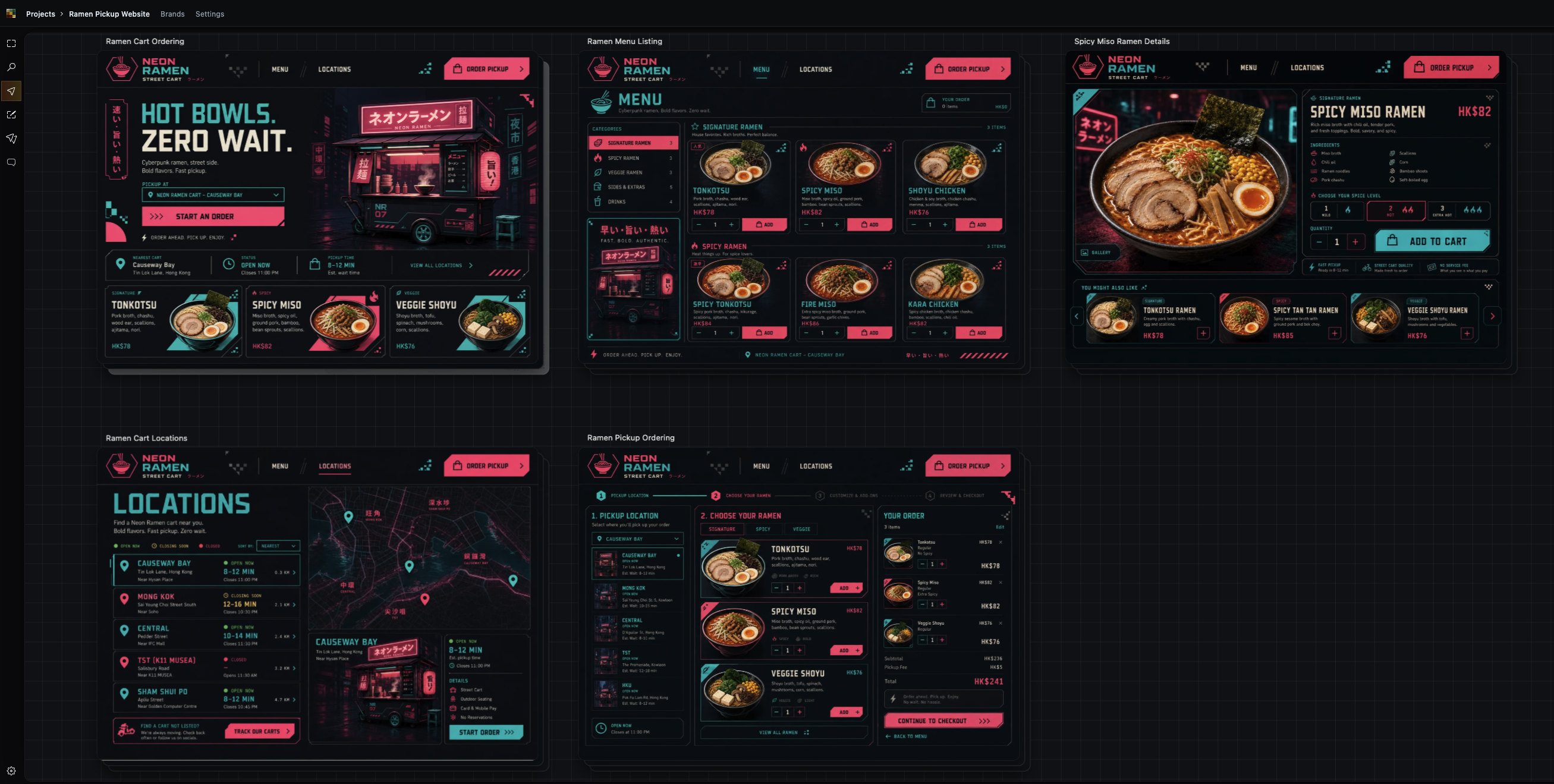
Opus is still best in class for this, but it's worth noting how well Gemini 3.7 does vs a more comparable LLM price wise, which is Grok 4.6: https://html.non.io/neonRamenGrok4.6 . I thought Gemini would blow Grok out of the water (it generally has in the past), but Grok has really caught up.
Everything the model sees is recorded in an append-only session log: system prompts, reasoning, tool calls and results, subagent scheduling, and every context injection. In the Trajectory view, you can inspect these records by source. Resume, fork, search, and replay all operate on the same event stream."
That's a killer feature, IMHO, and one that US models won't allow you to do, as their traces are encrypted, obfuscated, etc. and have to be extracted via various workarounds (that violate the terms of service).
If you want to be able to improve your tools that work with models, you have to be able to assess what the models think is happening, how they think about and interact with the data you give them. And, the US models won't let you see that.
I bought $18 GLM official subscription yesterday (5.2, but new model version was already leaking on some docs), set it up with Claude Code harness... and I’ve bumped to $80 plan almost immediately. It’s the first model that agreed on a proper security research (red team scenario), executed it seamlessly, including 0-days in WP plugins, RCE, 6.8 kernel exploit adaptation, etc - while playing against another GLM agent as a defender (following HF story)!
I understand that such models can be used by malicious actors, but it’s fair to have it publicly available (and play on your side in case of emergency). This is what changes the world in a better way, I think, not the guardrails.
It started with a solar boom, many small home scale solar roofs popping up everywhere. Australia has a free trade agreement with much of the world, including China, and solar panels have literally dropped to 1/50th of the price they were in 1990 ($10/W to $0.2/W today). A shout out to the work that was done to establish dynamic grid pricing too.
Anyway that caused power prices to reliably go negative during the day as the solar boom led to too much energy being produced. So everyone started buying batteries (you can even get live feed in/out pricing as a consumer). In fact the government even today will pay you a $3000 subsidy to go install a battery. This is in a country where people can buy cheap batteries with no tariffs (free trade's amazing, seriously!). So everyone who could started doing it. For those in apartments etc. that couldn't easily install solar and batteries they won too since the entire power grid is now half the price.
Another consequence of all this, aside from the cheap power prices during a datacenter boom and Hormuz blockade is that fossil fuel usage is plummeting. Particularly gas https://ieefa.org/resources/slump-eastern-australia-gas-dema... . No need for a gas peak power plant when the grid is packed with batteries. Which is helpful since one of the main issues with the current blockade is a lack of gas globally.
I think it funny how much average engineers are beginning to discover the challenges of engineering leadership and program management. This has always been the bottleneck.
It's why managers and PMs want to be in standup. It's why slack exists and engineers are constantly being poked on it. It's why execs always talk about not getting too far away from the work. It's how seagull management happens. It's why program management is a job.
All those behaviors engineers hated about their bosses that kept them away from being focused on the code...they're starting to feel what it's like on the other side and reinventing the solutions instead of just reading a book about engineering management. Maybe we'll rebrand program management to "understanding ops" or something.
I wonder what AI would say about us if given the tokens to complain.
Hi I'm one of the authors of DeepSeek Harness. It's just an early developer preview version we're presenting in MIT license currently. Expect lots of rough edges and compatibility-breaking changes. Any feedback and suggestions are more than welcome!
I started an e-commerce brand on a Shopify site. I swore to myself I would never put up one of those stupid things that pops up "Someone bought X product an hour ago!" messages in the corner of the screen.
I ended up trying it. Boosted conversion rate meaningfully. Worth the price I pay in mild self-loathing.
It's worth realizing that, before computerized central offices, telephone wiretapping required running physical wires. Back when Rudi Giuliani was prosecuting organized time, not only did physical wires have to be run, the cops were billed for them as expensive private lines. His task force was spending about a million dollars a year with New York Telephone on wiretapping.
In one case, law enforcement didn't pay their bill, resulting in the person being wiretapped having the wiretap connection show up on their bill, blowing the case.
That resulted in the Communications Assistance to Law Enforcement Act, which mandated that central offices offer remote wiretapping. Capacity up to 1% of lines is required.
Back in the electromechanical era, the only call data that could be collected was outgoing dial pulses, using a "pen register".[1] (The one shown in Wikipedia is mine. It's a beautiful piece of antique brass telegraph technology. It records dial pulses as dashes, and has to be wound up like a clock, with a big brass key.) The Supreme Court decision allowing "pen registers" without a warrant refers to these "extremely limited" devices. That definition has been stretched and stretched by law enforcement into all non-voice data collected by telcos.
We have LLMs try to generate descriptions of PRs for us and they're pretty universally disliked. They're always overly-complex descriptions of the mechanical changes and have no sense of motivation.
Also, a huge reason to understand the code yourself is to make sure the LLM isn't wrong, but this doesn't work if an LLM is itself generating the understanding.
Since it might be helpful to some, here's my current commandline for llama.cpp running on an RTX 4090 with my monitor moved to the iGPU to free up all of its VRAM.
Identical to the qwen3.6 config. With a prompt like "svg owl" (which can reuse quite a lot compared with creative writing or similar, so ngram-mod shines), I get about 70-80t/s like this, with a memory overclock of about 1.5GHz
I’ve been doing some heavy work on a personal project lately. I burned through the limits on Claude, the plus a few hundred dollars in credits, and ultimately decided to move to an OpenAI account just so I can keep going.
I was surprised to find that OpenAI Sol is much much nicer to work with than Opus 5 or Fable at the moment. Especially on Opus 5, the way it communicates is just exhausting. It keeps “being honest” and “confessing” mistakes and just generally talking a lot. I felt like I had to really dig to see what it’s doing.
The project involves OCR, and despite repeated instructions not to, both Claude models keep spinning out a bunch of agents to re-invent the OCR setup, and they inevitably seem to invent a primitive serial version that takes 20x the time, or longer, to complete, and then running it against thousands of docs. Basically I have to watch it like a hawk or it just spins out on red-teaming tasks that take hours and hours.
I don’t know what its system prompt is, but Sol/Codex is just so much nicer to talk to. It only asks exactly what’s needed, it tells me only what I need to know, and it is just generally workmanlike. And it has not once decided to spawn an agent that spends hours pointlessly burning tokens and CPU cycles re-inventing the OCR process. I’m really liking it.
OpenAI and Anthropic are both seeking trillion IPOs, while Chinese labs are pumping out open-weight models that are free for US providers to host and monetize.
These Chinese models cost less of US SOTA models to run, even if they are less capable. Providers can just run them, offer cheap tokens, and pocket the margin.
I just don't see how you justify a trillion valuation for US AI labs when the underlying models are being commoditized this fast.
> Let’s say every company gets about three innovation tokens. You can spend these however you want, but the supply is fixed for a long while.
This is one of my favorite blog posts, and it can basically be encapsulated in the idea of "innovation tokens." It is one of the most useful concepts I have had as a PM / eng leader in my career. It helps actually make the the right tradeoffs, and helps even more in explaining those tradeoffs to colleague of all levels. Highly recommend.
Apparently they are scanning OSS and popular software at scale and disclosing the vulnerabilities they found: https://cvd.z.ai/
Most of these are under embargo, but it seems there are a lot of CVE here from a wide range of popular software, many considered critical or high.
I understand the argument of "people are not actively looking", but isn't the cost for such a scan getting lower by the week, and Anthropic's Project Glasswing is supposed to find them quite a while ago?
> It’s much easier to say someone else’s job is going to be fully replaceable by AI when you don’t actually know what they do.
Too true. This isn't limited to AI, either. The most obvious example in my lifetime was during peak blockchain hype, when people who had never worked in finance convinced themselves that blockchain was going to act as the backbone for how money gets moved around. As if the problem that needing solving was Bank of America doesn't trust Capital One to update a number in their database.
The nice thing about AI, at least, is I can always push back and tell people, "Sure, we can do this with AI. I just need you to use Claude or ChatGPT manually to prototype how it would work." This normally results in the requestor realizing that there's human judgment calls involved in the inputs, process, or outputs that require meatbag intelligence.
I cannot wait for the accompanying Black Hat talk. Christopher Domas is one of my absolute favorite all-time hackers. He does such a fantastic job of explaining his work. Some of my favorite talks of his:


Sentences that orbit a point, then jump to it like it's a revealed insight.
Unnecessarily abstract phraseology. Constantly using inanimate nouns as the subjects in sentences in order to unlock variety in verb choice, especially when it helps construct a sentence where the real action can 'land' like a surprise at the end.
It is definitely more capable, and yes, I've found it can make unwarranted decisions, but actually I've found Fable worse for that, particularly if it's off in a subagent somewhere out of sight.
And comments are out of control. I have a subsystem in my hobby app that I wrote over a couple of weekends with Opus + Fable. After ~30 or so commits it apparently started instructing subagents to copy the "existing verbose comment style of the codebase" - a verbose style it initiated. A review of the code showed it was approaching 3:1 comments to code ratio. I spent a day's worth of tokens (5x) rephrasing and eliminating comments.